
Conditional Release and Firearms: A Gun Owner's Storage Guide
Opening your home to a family member or friend who is returning to the community on parole is a generous, important thing to do. A stable place to live is one of the biggest factors in a successful reintegration. But if you're a lawful firearm owner, it raises a question most people don't see coming: what happens to your firearms when one of the conditions of their release is that there be no firearms where they live?
The good news is that this is a common, well-understood situation, and there's a simple, lawful solution that lets you support your loved one without giving up your firearms.
What "conditional release" means
"Conditional release" is the umbrella term in Canada for the supervised release of someone serving a sentence — it includes temporary absences, day parole, full parole, and statutory release, all governed by the Corrections and Conditional Release Act. A person on conditional release agrees to follow a set of conditions while they're in the community.
One of the standard conditions that applies to everyone on parole and statutory release is that they are not to own, possess, or have control of any weapon . On top of that, the Parole Board can add special conditions tailored to the individual. In practice, this very often means the home they live in needs to be free of firearms.
It isn't only parole
The same need comes up in several related situations, and the practical answer is the same in each:
- Court-ordered weapons prohibitions. Under sections 109 and 110 of the Criminal Code , a court can prohibit a person from possessing firearms — often for ten years, and in some cases for life. These orders are entirely separate from parole and can apply to someone who was never incarcerated.
- Bail (judicial interim release). Someone awaiting trial is frequently released on conditions that include not possessing weapons.
- Probation. A probation order can carry a weapons condition as well.
If you're taking in someone in any of these circumstances, the question of firearms in the home is the same — and so is the solution.
The key point: it's about access
Here's the part that trips people up. The prohibition is on your loved one , not on you. You haven't done anything wrong, and you don't lose your right to own firearms.
But as the lawful owner sharing a home with a prohibited person, the responsibility shifts to you to make sure that person cannot access your firearms. The Criminal Code allows conditions to be placed on a lawful owner who lives with a prohibited person, specifically to prevent them from giving that person access. If a firearm in your home turned out to be accessible to someone under a prohibition, both of you could be exposed to serious legal consequences — and it could jeopardize their release.
That's why "no firearms at the residence" is so common as a condition. The cleanest, lowest-risk way to meet it is simply to remove the firearms from the house entirely.
Why off-site storage beats the alternatives
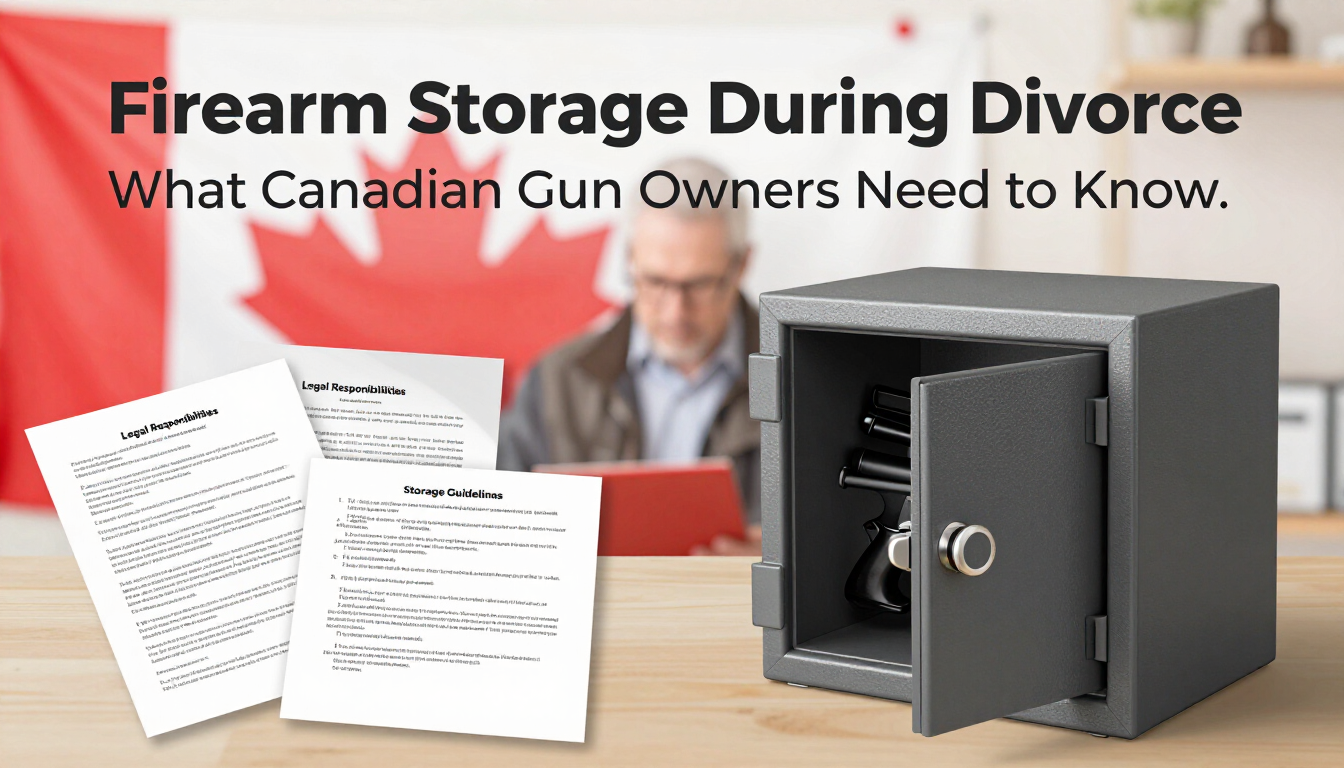
You might wonder whether a locked safe is enough. The problem is that a safe in the same home still invites hard questions: Who has the combination? Could it be opened? Is the firearm truly inaccessible to the other person? Even if you're scrupulous, you may be left proving a negative to a parole officer or the police.
Moving the firearms out of the residence removes all of that doubt. The home is firearm-free, full stop — there's nothing to interpret and nothing to worry about during an already sensitive time.
And critically, placing firearms into licensed storage is not surrendering them. You are not giving them up, selling them, or forfeiting them. You retain ownership the entire time, and you get them back when your loved one moves on, when the condition is lifted, or whenever it suits you.
Where Steller fits
This is exactly the kind of situation we handle at Steller Management. We're a federally licensed firearms storage facility (storage licence 13848590) based in British Columbia and expanding to Alberta. We can take your firearms — non-restricted, restricted, or prohibited — into secure, off-site storage so your home is compliant while your family member or friend gets back on their feet.
We handle the RCMP storage paperwork as part of bringing firearms into our care, we keep things discreet, and there's no fixed end date — store for a few months or a few years, and arrange the return whenever you're ready. For a household trying to do the right thing on a tight timeline, having the firearms safely off-site with the paperwork handled is one less thing to worry about.
A few practical notes
Every release is different, and this article is general information, not legal advice. Before you make arrangements, it's worth confirming the specifics:
- Read the actual conditions. The exact wording of your loved one's release, prohibition, bail, or probation order is what governs — confirm what it requires.
- Talk to the parole or probation officer. They can tell you exactly what's expected of the household and will generally be glad to see you taking it seriously.
- When in doubt, ask a lawyer or the Canadian Firearms Program (1-800-731-4000) about your obligations as a firearm owner.
Supporting someone through reintegration is hard enough without a firearms compliance problem hanging over it. If you need your firearms out of the home quickly, safely, and legally, we're glad to help — and to give them back when the time is right.
Steller Management
Phone: 604-305-4612
Email: info@stellermgmt.com
Website: stellermgmt.com
This article is provided for general informational purposes only and does not constitute legal advice. Conditions of release, weapons prohibitions, and firearms law in Canada are specific to each case and subject to change. Always confirm the exact requirements with the supervising parole or probation officer, the governing court order, and a qualified lawyer.